
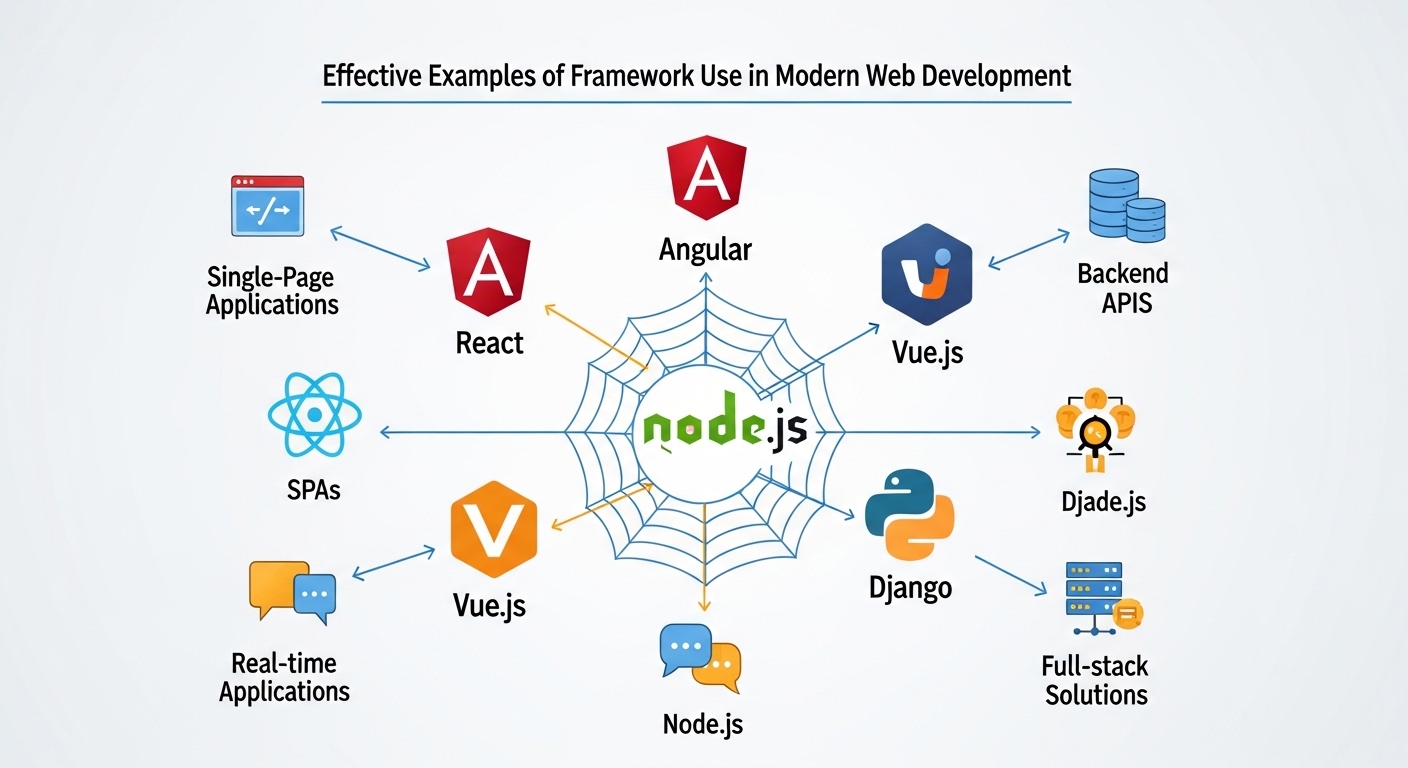
Effective Examples of Framework Use in Modern Web Development
1. React.js
React.js is one of the most widely adopted JavaScript libraries, primarily because of its component-based architecture. Facebook developed React and it allows developers to break down complex interfaces into reusable components. A prime example of its effectiveness can be seen in applications like Netflix. The streaming platform uses React for its front-end to ensure a smooth, dynamic user experience across devices. The virtual DOM feature enhances performance by preventing unnecessary re-rendering, making applications faster and more efficient.
2. Angular
Angular, developed by Google, is a platform for building mobile and desktop web applications. It uses TypeScript, which adds static typing to JavaScript, greatly improving developer productivity and code maintainability. A notable example is Google Cloud Platform. Angular is used for its dashboard and various admin interfaces due to its robust data-binding and dependency injection features that allow for dynamic updates and a single-page application (SPA) experience without full page reloads.
3. Vue.js
Vue.js has gained traction for its progressive framework approach, allowing developers to incrementally adopt it in projects. Alibaba, a leading e-commerce platform, utilizes Vue.js for its lightweight nature and simplicity in creating interactive UIs. The flexibility of Vue enables developers to integrate it into larger projects, thereby improving existing applications with minimal overhead. This adaptability has proven essential for e-commerce sites needing rapid iterations on their user interface.
4. Django
Django is a high-level Python web framework known for its “batteries included” philosophy, allowing developers to focus on building rather than solving common web development tasks. Instagram is a case in point, as its backend is primarily built on Django. The framework simplifies database interactions with its ORM and promotes rapid development by incorporating features like a built-in admin panel, user authentication, and security practices which reduce common web vulnerabilities.
5. Ruby on Rails
Ruby on Rails, often simply Rails, is an intuitive and beginner-friendly web application framework written in Ruby. It adheres to the convention over configuration principle. GitHub, the world’s leading code repository platform, is a standout example of Rails’ capabilities. The framework simplifies complex database relationships and routes beautifully, allowing for rapid feature development. This focus on developer happiness and code elegance helps GitHub continuously innovate while maintaining a high code quality standard.
6. ASP.NET Core
ASP.NET Core is a cross-platform, open-source framework for building cloud-based web applications. Microsoft Azure utilizes ASP.NET Core for its high performance and ability to handle heavy traffic. The framework’s model-view-controller (MVC) architecture separates concerns effectively, allowing for scalable application development. With its integration of dependency injection, developers can create more testable and maintainable applications.
7. Laravel
Laravel is a PHP framework that emphasizes elegant syntax and provides robust features like Eloquent ORM and Blade templating engine. One of its prominent users is 9GAG, a viral content platform. Laravel’s built-in tools for user authentication, sessions, and routing facilitate the rapid development of complex applications. The framework’s community support and a plethora of packages extend its functionality, ensuring developers can find solutions to common problems quickly.
8. Flask
Flask is a micro web framework for Python that is lightweight and modular. It is often preferred for smaller applications or APIs. Pinterest is an engaging example of Flask at work. The framework’s flexibility allows it to be integrated into existing platforms without significant reconfiguration. Flask’s simplicity lets developers start small and grow their application as needed, which is key for evolving platforms like Pinterest that rely on constant feature enhancements.
9. Elementor (for WordPress)
Elementor is not a framework per se, but it’s a powerful page builder for WordPress that utilizes existing frameworks like Bootstrap for responsive design. Websites like Vogue and BBC America utilize Elementor to create visually stunning pages without needing to write code from scratch. With pre-built templates and easy drag-and-drop functionality, content creators can build complex layouts without extensive technical skills, thus democratizing web development.
10. Next.js
Next.js is a React-based framework that enables server-side rendering and static site generation. It is tailored for performance, making it ideal for large-scale applications and those needing SEO optimization. The e-commerce giant Shopify leverages Next.js to build engaging storefronts that load quickly and are optimized for search engines. This helps improve user experience and boosts conversion rates, showcasing how modern frameworks can directly impact business success.
11. Svelte
Svelte stands out for its innovative approach to building web interfaces by shifting most work to compile time instead of using a virtual DOM. The application Next.js uses Svelte for rapid prototyping and interactive elements, as its minimalistic design leads to faster load times and superior performance. This lightweight framework aids developers in creating applications with fewer performance bottlenecks, allowing for complex functionalities.
12. ASP.NET MVC
ASP.NET MVC is a framework within the ASP.NET framework, encouraging a clean division of concerns. Stack Overflow employs this architecture, as it handles a massive user base with various dynamic content needs. The framework’s routing capabilities allow for user-friendly URLs, and its support for RESTful web APIs has made it a favorite for modern applications needing integrated services.
13. Express.js
Express.js is a web application framework for Node.js guiding RESTful APIs and single-page applications. It underpins platforms like PayPal for rapid server-side development, providing a minimalistic environment for building web applications and APIs. Its middleware system streamlines application behavior by allowing developers to “stack” functionality as needed, which is particularly beneficial for large-scale applications with multiple endpoints.
14. Bootstrap
Bootstrap is a front-end framework for designing responsive websites. Government websites like the U.S. Department of State use Bootstrap to maintain a consistent look and feel across various devices. The grid system, pre-built components, and modifiable styles help developers create mobile-first designs effortlessly, ensuring accessibility and usability for all visitors.
15. Ionic
Ionic is a hybrid mobile app framework that allows developers to create cross-platform applications using web technologies. The framework is used in applications like MarketWatch to deliver user-friendly mobile experiences effectively. By facilitating the same codebase for both iOS and Android, Ionic saves time and reduces overall development costs.
Developers selecting the right framework for their projects should consider factors such as performance, community support, scalability, and the specific requirements of the application. Each framework brings unique strengths to the table, which adapt to business needs, fostering innovation and efficiency in web development. As the landscape of web technologies continues to evolve, these frameworks exemplify effective practices in modern development.